Should PRs Wait for Citizenship Before Buying a New Launch? The ABSD Math

Quick answer: A Permanent Resident pays 5% ABSD on a first property versus 0% for a Singapore Citizen — on a $2 million purchase, that's $100,000 in cash, due within 14 days of signing. Whether it's worth waiting for citizenship before buying depends on how long that approval might realistically take versus how much your target precinct could appreciate in the interim, since a first-mover phase in a transforming district often carries the largest re-rating potential.
This is one of the most common questions I get from Singapore Permanent Residence (PR) clients, and it rarely has a clean answer — because it isn't really a property question. It's a timing question, and timing questions require comparing two uncertain things against each other: how long your citizenship application might take, and how much a precinct might move while you wait.
Let me walk through the actual numbers, because the gap is larger — and more layered — than most people assume.
The ABSD Gap, in Real Terms
As a PR, your Additional Buyer's Stamp Duty on a first residential property sits at 5%. As a Singapore Citizen, that same first property carries 0% ABSD. On a $1.5 million unit, that's $75,000. On a $2 million unit, $100,000. This is cash, due within 14 days of signing — it cannot be financed through your mortgage.
If you're a PR weighing whether to apply for citizenship before buying, that $75,000–$100,000 is the number you're implicitly comparing against your expected wait time. The honest follow-up question is: what does that capital actually do for you if you deploy it now, into a specific launch, versus holding it while an application processes?
It's Not Just This Purchase — It's Your Next One Too
Here's the part of the calculation most PR buyers miss, because they're focused on the property in front of them rather than the portfolio they're building.
If you buy as a PR and later become a citizen, your first property was taxed at 5%. But your second property — whenever you're ready to add to your portfolio — is taxed at the PR rate that applied at the time you owned it as your second, not a rate that improves retroactively once you're a citizen. In practice, this means the sequencing question isn't "5% now or 0% later" in isolation — it's part of a wider structure where a Singapore Citizen's second property sits at 20% ABSD, versus 30% for a PR's second property. That's a 10-percentage-point gap that compounds on top of whatever you decided about property one.
For a client who already knows they want to hold more than one investment property over the next five to ten years, this changes the framing entirely. The decision isn't "should I buy this one launch as a PR or wait" — it's "given my citizenship timeline, what's the most efficient order to acquire a portfolio, and does it change which property should be first versus second."
That's a modelling exercise, not a rule of thumb, and it's worth doing before you commit to either purchase, not after.
Why Timing the Precinct Matters as Much as Timing the Citizenship
Citizenship timelines are genuinely outside your control. Precinct transformation, by contrast, often follows a more visible arc — and the earliest phase of that arc is typically where the largest capital appreciation occurs, precisely because comparable transactions don't yet exist to anchor pricing.
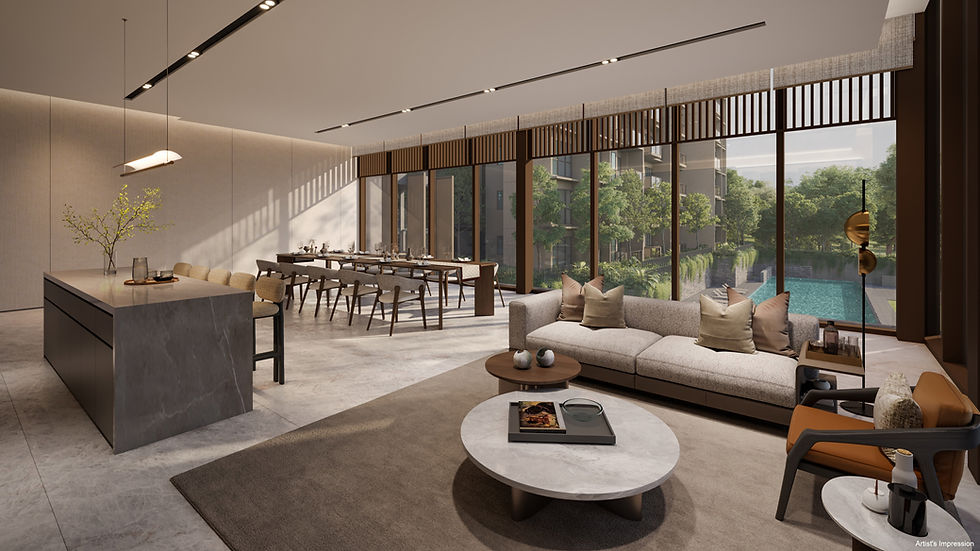
A useful current case study: Dunearn House, the first non-landed residential launch in the Swiss Club subzone in 33 years, positioned at the edge of the Turf City redevelopment and elevated above the surrounding Good Class Bungalow enclave. A first-mover project in a precinct with no recent residential comparable tends to be priced conservatively relative to where the market settles once the transformation matures and later launches arrive with stronger comparables to lean on.

If a client's realistic citizenship timeline runs two to three years, and a first-mover precinct like this re-rates meaningfully in that same window once the surrounding masterplan delivers, the $100,000 ABSD saving has to be weighed against the opportunity cost of not having been in the market at all during that period — on top of whichever unit would have been sold to someone else in the meantime.
I'm not suggesting the math always favours buying now. Sometimes it doesn't. But it's a genuine trade-off, not a foregone conclusion, and it deserves to be modelled with real numbers — including the second-property numbers above — rather than decided on instinct.
A Framework, Not a Rule
A few questions worth answering honestly before you decide:
How firm is your citizenship timeline? If you have a realistic, evidence-based estimate rather than a hope, that number drives everything else.
Is this a one-property decision or a portfolio decision? If you expect to buy again within the ABSD structure's lifetime, model both purchases together, not just the one in front of you.
Is the property a home or an investment? The ABSD calculus changes if you plan to live in it for a decade versus exit within five years.
Does the precinct have a visible transformation story, or is it already mature? First-mover pricing only has room to re-rate where the surrounding masterplan hasn't yet delivered. A mature, fully-built-out district doesn't carry the same upside.
Can you fund the ABSD in cash today without compromising your broader financial position? This is a binding constraint before it's an investment decision.
There's no universal answer here, and I'd be doing you a disservice if I pretended otherwise.
Where This Leaves You
If this is a decision you're weighing — whether it's timed against a specific launch like Dunearn House or against your broader portfolio sequencing — I'd rather run the actual numbers against your situation than leave you to estimate them. Get in touch, or WhatsApp me directly, and we can work through it together.
About Elvis Loo

I'm a Group Division Director at ERA Realty Network, and I've specialised in Singapore's new and resale residential markets — new launches, en bloc opportunities, and property investment strategy — since joining the industry in 1995. I'm also a certified ACTA trainer for CPD courses with the RIA School of Real Estate.
My clients include Singapore Citizens, PRs, and foreign investors who have built portfolios in the CCR and RCR. My approach isn't to push you into Singapore property investment — I work with clients on data-backed decisions, investment fundamentals, and the objective of building generational wealth.
All enquiries are treated with complete discretion.
This article is for general information and does not constitute financial, tax, or immigration advice. ABSD rates, eligibility, and citizenship application outcomes are determined by IRAS and ICA, respectively, and should be verified directly with the relevant authority or your own advisor.